The short answer
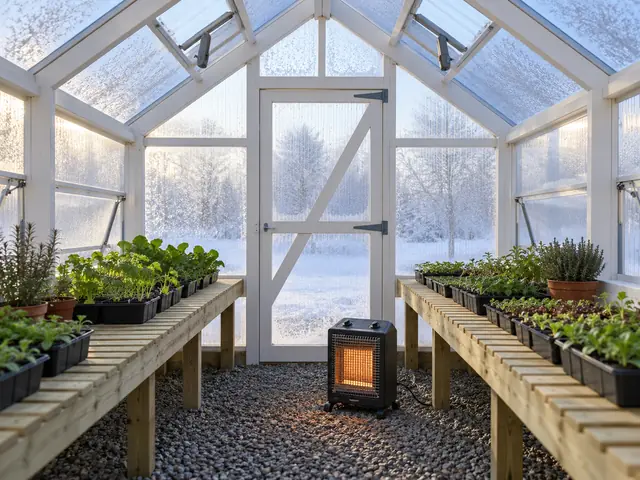
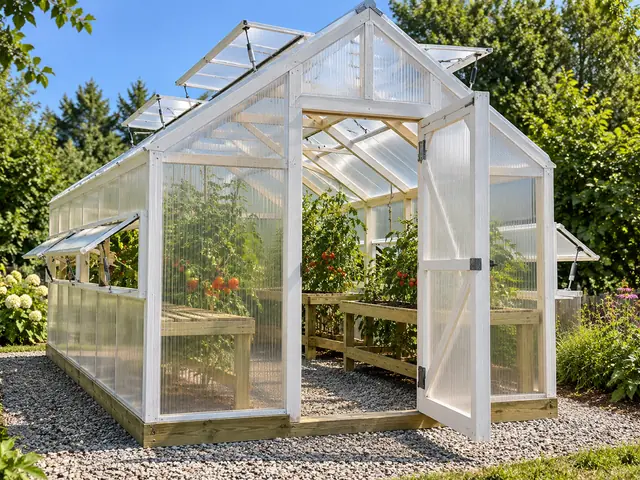
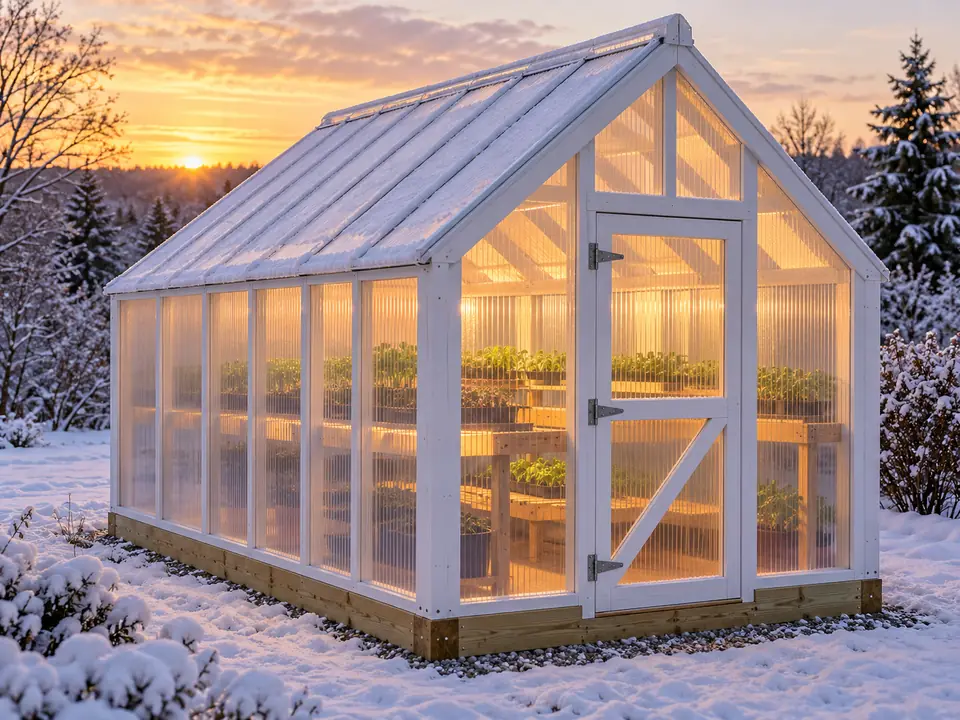
To keep a greenhouse warm in winter, first cut the heat it loses: twin-wall glazing instead of a single layer, tight vents and door, a sheltered site, a knee wall or a lean-to against the house. Then size a vented heater to the loss on your design night. Our 8x12 in 8 mm twin wall needs about 7,701 Btu/h to stay at 40 F when it is 10 F outside, and 14,119 Btu/h to stay at 55 F on a 0 F night.
How to keep a greenhouse warm in winter has two halves, and the order matters: first make the greenhouse lose less heat, then buy a heater big enough for what is left. Skipping the first half is the expensive mistake, because the heater, the fuel and the electricity all scale with the loss. This guide puts numbers on both halves with the same method UGA1 Extension uses in its bulletin on greenhouse heating, applied to the greenhouses our designer draws.
The short version for our 8x12 in 8 mm twin-wall polycarbonate: about 7,701 Btu/h keeps it at 40 F when it is 10 F outside. Run your own size in the greenhouse heater size calculator.
- 1UGA Cooperative Extension Greenhouses: Heating, Ventilation, and Cooling, Bulletin 792 (J. W. Worley, revised by R. S. Ferrarezi, 2025)
- 2UGA Extension UGA Extension, B 910, 2023-11-17
How much heat a greenhouse needs
A heater has to replace the heat lost on the coldest still, cloudy night you plan for, when the sun gives nothing back. UGA1 Extension’s Bulletin 792 splits that loss three ways:
- Through the cover: each surface’s area times its U-value times the temperature rise you want.
- Through air leaks: 0.02 times the air volume times the number of air changes per hour times the rise.
- Along the base: 0.8 Btu per hour per foot of perimeter per degree, for an uninsulated edge.
On the 8x12, the cover is by far the largest of the three. That single fact explains almost everything in the rest of this guide.
Pick the two temperatures
UGA1 Extension says most greenhouse plants do well at night temperatures of 55 to 65 F, puts the minimum for most situations at 40 F, and says to set the thermostat at 40 F if all you want is frost protection. For the outside number, UGA’s rule is your average daily minimum January temperature minus 15 F. Then check the heater against your record cold, so a bad night does not freeze the plants.
What each of our plans needs
| Plan | Frost protection: 40 F in, 10 F out | Growing: 55 F in, 0 F out |
|---|---|---|
| 6x8 greenhouse | 4,889 Btu/h | 8,963 Btu/h |
| 8x12 greenhouse | 7,701 Btu/h | 14,119 Btu/h |
| 10x12 greenhouse | 8,963 Btu/h | 16,432 Btu/h |
| 12x20 greenhouse | 15,724 Btu/h | 28,827 Btu/h |
| 6x12 lean-to | 4,926 Btu/h | 9,031 Btu/h |
| 8x12 corrugated | 14,459 Btu/h | 26,508 Btu/h |
All with average wind and new, tight construction. The lean-to leaves out the house wall, which is heated on the other side.
- 1UGA Cooperative Extension Greenhouses: Heating, Ventilation, and Cooling, Bulletin 792 (J. W. Worley, revised by R. S. Ferrarezi, 2025)
- 2UGA Extension UGA Extension, B 910, 2023-11-17
Hold the heat in first
Every Btu you stop losing is one you never pay for. In order of how much they matter on a small greenhouse:
Glazing: one layer or two
The U-value of the cover sets the size of the biggest line. Palram3 lists 3.5, 3.3 and 2.9 W/m2 K for its 6, 8 and 10 mm SUNLITE twin wall, which is about 0.62, 0.58 and 0.51 in US units; Plaskolite4 publishes almost the same for its own twin wall. UGA1 and NRAES5 give about 1.2 for a single rigid panel or film. NRAES sums it up: a second layer cuts conduction loss by about half and light by about a tenth. In the calculator these U-values are modeling assumptions for the arithmetic, not tested performance of a sheet in your greenhouse; for corrugated SUNTUF no U-value is published in what we read, so the single-panel figure stands in.
On the 8x12 at 40 F inside and 10 F outside:
- 10 mm twin wall: 6,938 Btu/h.
- 8 mm twin wall: 7,701 Btu/h.
- 6 mm twin wall: 8,137 Btu/h.
- Corrugated, one layer: 14,459 Btu/h.
Palram3 does note that single-wall corrugated may suit greenhouse roofs in snow-bound areas better, because it carries heavier snow. That is a structural choice; if you heat, it costs you at every cold night.
Air leaks
UGA’s1 table gives 0.75 to 1 air change per hour for new glass or fiberglass construction, and 2 to 4 for old glass houses in poor condition. Leaks come from gaps around doors and torn covers, and UGA singles out fan shutters that no longer close tight. Vent lids seal better than shutters but still need upkeep. Before winter, check that every lid closes flat on its weatherstrip, the door meets its stops, and the sheet ends are taped and capped.
Wind
UGA1 adds about 20% to the heat requirement for a house on a windy hill. A fence, hedge or building on the side of the prevailing winter wind, kept far enough away not to shade the glazing, is heat you save every night.
The walls below the benches
A framed knee wall replaces glazing where plants on the floor get the least light anyway. But a plain plywood knee wall is not warmer than twin wall: UGA1 gives R 1.43 for 1/2 in plywood, a U of about 0.70 against 0.58 for 8 mm twin wall. On our 8x12 with a plain 24 in knee wall, the load is 7,989 Btu/h against 7,701 with glazing to the base. The gain comes when you fill the stud bays: NRAES5 lists 0.12 for 1 in softwood plus 2 in of foamed urethane board, about a fifth of the twin wall figure.
The base edge
NRAES5 and UGA1 halve the perimeter loss, from 0.8 to 0.4 Btu per hour per foot per degree, with insulation equal to 2 in of foamed polystyrene reaching 24 in into the ground. On a small greenhouse this is a modest line, but it also keeps the soil along the walls warmer, where the benches stand.
Night covers and the house wall
NRAES5 describes movable insulation, a thermal blanket stored in the day and drawn over the crop at night; it also cuts air exchange. And a lean-to against a heated house wall loses less from the start. UGA1 notes that a lean-to can often be heated with an extension of the home heating system on its own thermostat, or with a fan blowing warm air in through a window or door.
- 1UGA Cooperative Extension Greenhouses: Heating, Ventilation, and Cooling, Bulletin 792 (J. W. Worley, revised by R. S. Ferrarezi, 2025)
- 2UGA Extension UGA Extension, B 910, 2023-11-17
- 3Palram SUNLITE Technical Guide (07.2019)
- 4Plaskolite Plaskolite, Polygal Multiwall guide, (c) 2024
- 5NRAES Greenhouse Engineering, NRAES-33 (R. A. Aldrich and J. W. Bartok Jr., 1994)
Choosing and fitting the heater
Size it
Buy a heater rated at or above the loss on your design night. UGA1 Extension’s hobby greenhouse bulletin asks you to allow a safety margin in heating capacity and to consider future expansion. A plug-in 1,500 W electric heater gives 5,118 Btu/h, so the 8x12 needs two of them for 40 F on a 10 F night.
A worked example: the 10x12 in a cold climate
Say your January nights average 25 F. UGA’s1 rule gives a design night of 25 - 15 = 10 F. You grow overwintering herbs and lettuce, so you want 40 F inside, which makes the rise 30 F. The 10x12 in 8 mm twin wall loses 8,963 Btu/h on that night, the same figure the calculator gives. Divide by 5,118 Btu/h per 1,500 W heater and you need a little under two, so two plug-in heaters on separate circuits, which also gives you the second unit UGA prefers. If you grow seedlings that need 55 F, the load on a 0 F record night is 16,432 Btu/h, which is four 1,500 W heaters, and that is the number to buy against.
The same arithmetic works for any size. The calculator multiplies each surface’s area by its U-value, adds the air leak and base terms, and applies the 20% wind allowance if you choose the exposed site.
What a cold night costs to run
Electric heat is the easiest to price. A heater’s watts times the hours it runs is its energy in kilowatt-hours, and your bill shows the price per kilowatt-hour. The 8x12 at 40 F on a 10 F night needs about 2,260 W, so if the heater ran flat out for a 12 hour night it would use about 27 kWh; at an electricity rate of $0.16 per kWh, an assumed figure that you should replace with your own bill, that is about $4.30 for that night. Thermostats cycle the heater, and milder nights need much less, so use this as the ceiling for the coldest night, not the average. Halving the loss halves the bill, which is why the glazing section comes first in this guide.
Electric
Electric heaters are clean and need no chimney. UGA1 notes that electric heat can be very costly and is usually used only in very small greenhouses. The calculator shows the kilowatt-hours of a full night at the design temperature, so you can price it at your own rate before you commit. Any new outdoor circuit is a job for an electrician; UGA says electrical work should be done by professionals to local code.
Gas, oil and kerosene
UGA1 warns that a gas, oil or coal heater needs a fresh air supply and an unobstructed chimney so carbon monoxide does not build up, that all greenhouse heaters should be vented for plant and human health, and that only high grade, low sulfur kerosene avoids sulfur dioxide damage. Clemson6 Extension does not recommend unvented heaters that burn propane or kerosene.
Forced air, benches and soil
UGA1 calls a forced-air furnace with a duct or plastic tube along the ridge the best system for a small greenhouse, because the tube spreads the heat with no cold spots. Hot water bench heating and soil heating cables warm the root zone directly, and UGA notes that higher bench temperatures can be provided with soil-warming equipment while the air stays cooler.
Two units, one alarm, one fan
UGA1 prefers two or more small heaters to one big one, so one failure does not freeze the house, and suggests an alarm for heater faults and power cuts. Clemson6 recommends small circulating fans with a combined capacity of about a quarter of the air volume per minute, run all winter, so warm air does not pool at the ridge: about 96 sq ft of floor and 700 cu ft of air on the 8x12 means roughly 175 cfm.
- 1UGA Cooperative Extension Greenhouses: Heating, Ventilation, and Cooling, Bulletin 792 (J. W. Worley, revised by R. S. Ferrarezi, 2025)
- 2UGA Extension UGA Extension, B 910, 2023-11-17
- 6Clemson HGIC 1704 Clemson HGIC 1704, Hobby Greenhouses, 06/99
Heating without a mains supply
Searchers also ask how to heat a greenhouse in winter for free, naturally or without electricity. We found no extension publication that gives a tested free-heat method with numbers, so we will not quote one. What the sources do support:
- Lose less first. Everything in the hold-the-heat-in section is free after the build, and it is the only part of heating we can put a figure on.
- Use a house. A lean-to against a heated house wall starts with one side that loses almost nothing, and UGA notes it can borrow warm air from the house.
- Use fuel with a flue. A vented gas or oil heater needs no mains power for the burner, with the chimney and fresh air UGA requires. Plan for the fan or thermostat that may still need a small supply.
- Accept a lower setting. If the goal is frost protection only, 40 F is the setting UGA gives, and every degree below 55 F cuts the load: on the 8x12 the difference between 40 F and 55 F inside on a 10 F night is shown in the heater calculator.
Anything marketed as heating a greenhouse for nothing should be checked against the loss figure for your size: if the heat it claims to add is less than the Btu/h your greenhouse loses, the plants still get cold.
- 1UGA Cooperative Extension Greenhouses: Heating, Ventilation, and Cooling, Bulletin 792 (J. W. Worley, revised by R. S. Ferrarezi, 2025)
- 2UGA Extension UGA Extension, B 910, 2023-11-17
Common mistakes
- Sizing to the average night, not the design night. The heater is judged by the coldest night you plan for, not by the typical one.
- Forgetting the wind. An exposed site is a 20% larger heater by UGA’s figure.
- Buying an unvented heater because it is cheap. UGA and Clemson both say to vent greenhouse heaters.
- One big heater and no alarm. One fault and the whole crop freezes.
- Heating a leaky house. If the vents do not seal, a bigger heater only pays to warm the neighborhood.
- 1UGA Cooperative Extension Greenhouses: Heating, Ventilation, and Cooling, Bulletin 792 (J. W. Worley, revised by R. S. Ferrarezi, 2025)
- 2UGA Extension UGA Extension, B 910, 2023-11-17
- 6Clemson HGIC 1704 Clemson HGIC 1704, Hobby Greenhouses, 06/99
Winter ventilation
Heat and ventilation pull against each other in winter, but plants still need fresh air and dry leaves. Clemson6 gives 20 to 30% of the air volume per minute for winter exhaust ventilation, against 1 to 1.5 volumes per minute in summer. Open the roof vents a little on sunny winter days rather than not at all; the greenhouse ventilation calculator sizes the summer side.
- 6Clemson HGIC 1704 Clemson HGIC 1704, Hobby Greenhouses, 06/99
Plan the winter before you build
If you have not built yet, the heating choices are cheapest on paper. Thicker twin wall, a knee wall and a sheltered site cost little at build time and save every night after. Open the design above in the designer, or start from the free greenhouse plans, and read how to build a greenhouse for the full sequence.
Sources
Every number in this guide that does not come from our own greenhouse designer was checked against these 7 documents, numbered in the order the text first cites them and read between Oct 13, 2026 and Oct 14, 2026. 7 are extension services, codes and makers.
- 1UGA Cooperative ExtensionGreenhouses: Heating, Ventilation, and Cooling, Bulletin 792 (J. W. Worley, revised by R. S. Ferrarezi, 2025)
- 2UGA ExtensionUGA Extension, B 910, 2023-11-17
- 3PalramSUNLITE Technical Guide (07.2019)
- 4PlaskolitePlaskolite, Polygal Multiwall guide, (c) 2024
- 5NRAESGreenhouse Engineering, NRAES-33 (R. A. Aldrich and J. W. Bartok Jr., 1994)
- 6Clemson HGIC 1704Clemson HGIC 1704, Hobby Greenhouses, 06/99
- 7Purdue University Controlled Environment AgricultureCalculating Greenhouse Heating Requirements (A. Miller and K. Nemali)