The short answer
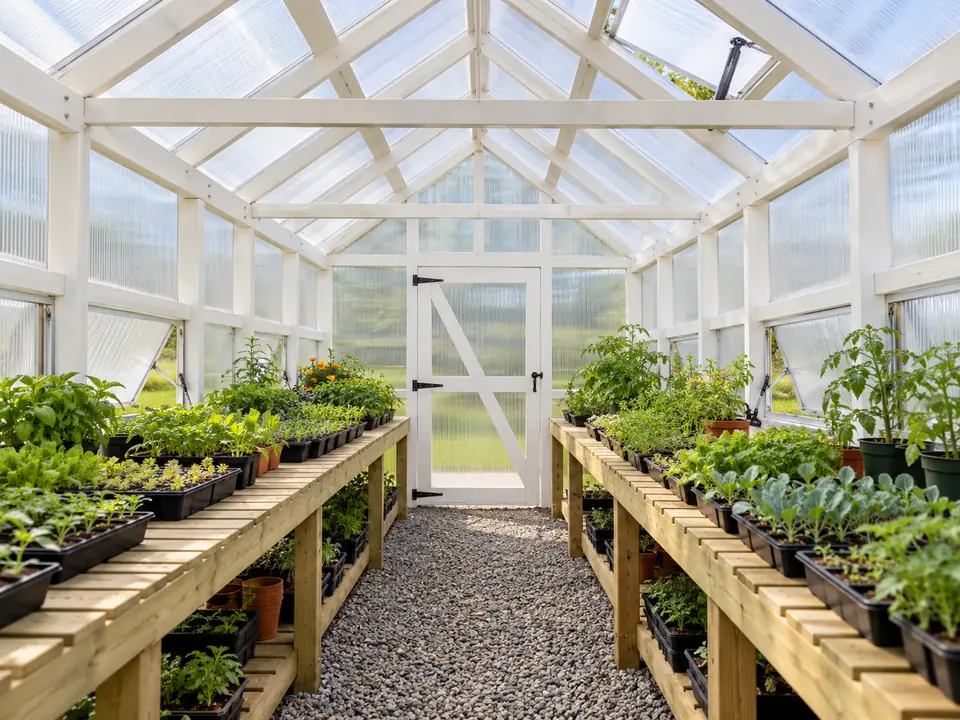
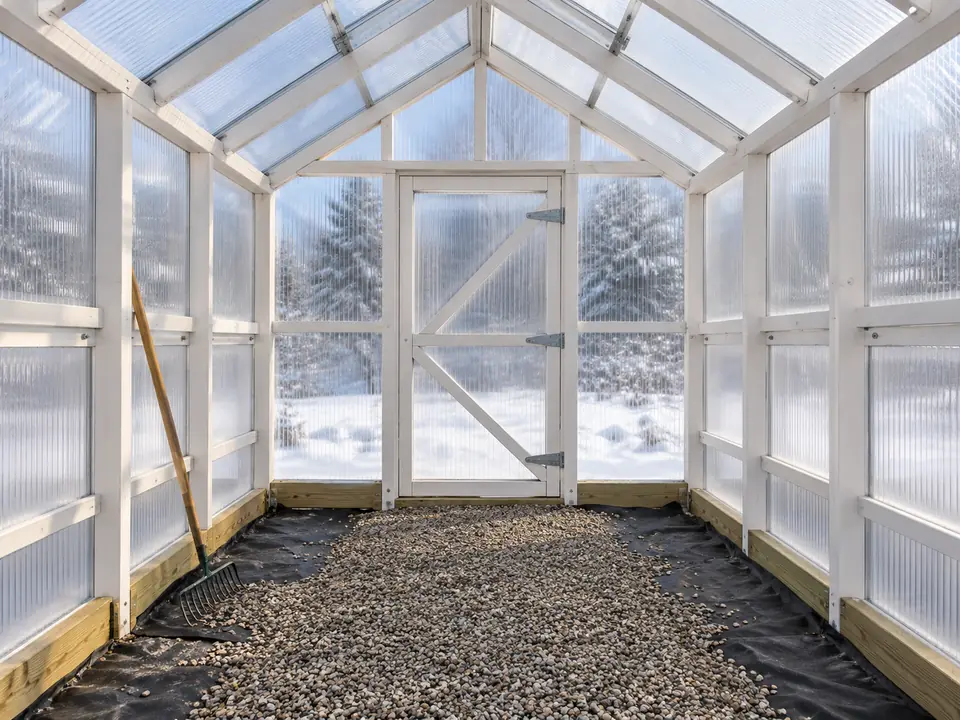
The best floor for most hobby greenhouses is pea gravel over landscape fabric, with pavers on the main path if you want a firm walk. Our 8x12 takes 0.9 cu yd of pea gravel, 3 in deep, for its 96 sq ft, about $26 to $36 at the quarry prices HomeGuide reported. UGA Extension says a hard surface is cleanest and easiest to walk on, but the area under the benches should always be water-absorbent.
The floor of a greenhouse is the surface you stand on, and it is a different decision from the foundation. Our foundation guide covers the structural base: timbers, blocks, a knee wall and the anchors that hold the frame down. This guide covers what goes inside it, on the ground between and under the benches.
Our plans count both. Under the base timbers goes a compacted gravel bed, 2 cu yd for the 8x12. Inside, as an option, goes 3 in of pea gravel over landscape fabric: 0.9 cu yd for the same house, which covers its 96 sq ft of floor.
What a floor has to do
UGA1 Extension, in its hobby greenhouse bulletin, puts the choice plainly. The paths and floor of a greenhouse can be gravel, cinders, crushed stone, concrete, brick or other material. A hard surface such as brick or concrete is cleanest, most attractive and easiest to walk on, but a loose surface absorbs moisture better and helps keep the humidity up. The areas under the benches should always be water-absorbent.
That gives three jobs for the floor: be firm enough to walk and push a cart on, let water go somewhere, and not make a mess of the humidity. No single material does all three, which is why many greenhouses mix two. UGA1 also says a walk used only to stand at the benches can be 18 to 19 in wide and that 24 to 30 in lets people pass, so the paved part of the floor is a strip, not the whole house.
- 1UGA Extension UGA Extension, B 910, 2023-11-17
Gravel
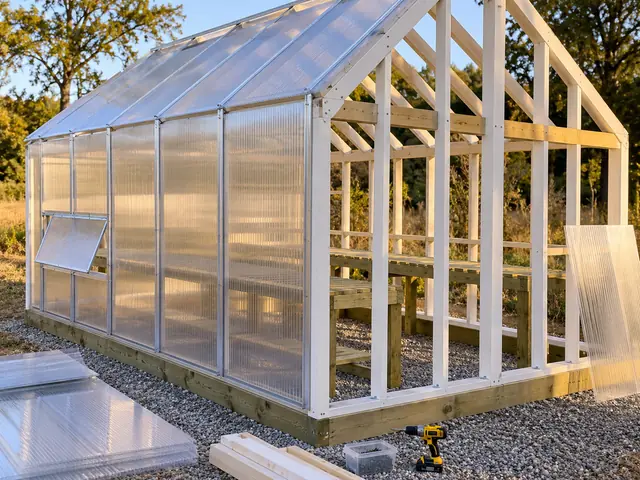
Gravel is what our plans draw. The floor is pea gravel, 3 in deep, over landscape fabric, so the weeds stay down and water goes through. The 8x12 takes 0.9 cu yd, and the 10x16 takes 1.5 cu yd. It is marked optional in the plan and it is not in the priced total, because bulk gravel is priced by the cubic yard at a quarry.
HomeGuide’s2 gravel price guide, updated December 19, 2025 and read by us on October 13, 2026, puts bulk pea gravel at $29 to $40 per cubic yard at a quarry. At that range the floor of the 8x12 is about $26 to $36, which is $0.27 to $0.38 per square foot of floor. Delivery and spreading are extra. The gravel for the whole 8x12, the base bed and the floor together, is $56 to $186 in our estimate.
Do not confuse this with the bed under the base. That one is 4 in of compacted crushed stone, 12 in wider than the greenhouse on each side, and it carries the frame. The pea gravel inside is only a surface. The foundation guide explains the bed.
Pavers and brick
Pavers give you the hard surface UGA1 describes, in the part of the floor you walk on most. The usual way is a strip down the middle of the aisle, with the pavers set into the pea gravel, and gravel left under the benches where the water has to go.
How much is a strip? Our 8x12 has a 37 in aisle between two benches that are 136 in long, which is about 35 sq ft of paver if you pave the aisle from end to end. That is our arithmetic from the plan, not a number from a source. Brick works the same way.
We have not priced pavers and our plans do not draw them. Prices vary by region, size and finish, so get the figure for your own store before you commit. Our greenhouse cost calculator shows the priced materials of the structure itself.
- 1UGA Extension UGA Extension, B 910, 2023-11-17
Concrete slab
A slab is the cleanest, hardest floor, and it is a real construction job, not a layer. Two points from the sources we use. NRAES3-33 prefers a continuous masonry or concrete wall under frames spaced 4 ft apart or closer, and says footings go below frost depth or at least 24 in down, so a slab for a greenhouse is a foundation question first. And UGA1 says the area under benches should be water-absorbent, so in our reading a slab needs a slope to a drain, or an open strip of gravel under the benches.
Our plans do not draw a slab, and the gravel bed under the base timbers drains through. If you build on an existing slab, the base timbers still need to be fixed down against wind uplift. Ask your building department before you pour a new one.
- 1UGA Extension UGA Extension, B 910, 2023-11-17
- 3NRAES-33 NRAES-33, Greenhouse Engineering, 1994
Weed fabric and mats
Landscape fabric is the cheap, quiet part of the gravel floor: it sits under the pea gravel, stops weeds and keeps the stone from sinking into the soil. It goes on a level, compacted base. Rubber or interlocking mats work as a soft, cleanable path on top of gravel or a slab, and they are the part you can lift for winter cleaning. We do not price either, so get your own numbers.
Wood is another matter. A wood deck on or near the ground has to be pressure-treated for ground contact (IRC4 R317.1.2), and wet wood in a humid greenhouse is a maintenance job. If you want a wood walk, use ground-contact lumber and keep it off bare soil.
- 4International Code Council International Code Council, 2021 International Residential Code, Chapter 3, R317.1.2 (codes.iccsafe.org)
Drainage and the base around it
Water has to go somewhere. A greenhouse sheds water at the eaves, and it gets wet inside from watering and condensation. The gravel bed under the base lets it drain, the pea gravel floor lets it through the surface, and the fabric keeps the two from mixing. What breaks the system is a floor that holds water against the base timbers, so slope any hard surface away from the walls.
The bed under the base is the one thing in this guide that is structural. Level it before you build, and read the foundation guide for the rest. When the frame is up, the build guide tells you when to spread the floor.
Cost per option for the 8x12
| Option | What it covers in the 8x12 | Cost we can source |
|---|---|---|
| Pea gravel over fabric | 0.9 cu yd, 3 in deep | About $26 to $36 for the gravel (HomeGuide, read October 13, 2026) |
| Pavers on the aisle | About 35 sq ft of aisle | Not priced here |
| Concrete slab | 96 sq ft | Not priced here |
| Whole greenhouse, materials | The priced list | $4,560.03 at the store prices we read between Sep 30, 2026 and Nov 21, 2026 |
The structure is the big number. Even a generous floor is a small part of it, so spend where it helps: gravel under the benches, firm pavers where you walk, fabric under both. If you also grow in raised beds inside, the raised bed soil calculator sizes the soil. Open the 8x12 plan to see the gravel line for your own size.
Check before you cut
Fabric before gravel
Lay the fabric on a level, compacted surface, lap the edges, and then spread the pea gravel to 3 in. Gravel on bare soil tends to sink into it.
Size the rest with the free tools
Sources
Every number in this guide that does not come from our own greenhouse designer was checked against these 4 documents, numbered in the order the text first cites them and read between Oct 10, 2026 and Oct 13, 2026. 3 are extension services, codes and makers; 1 is a secondary source (sellers' and builders' guides), marked, used only where no extension source, code or maker gives a number.
- 1UGA ExtensionUGA Extension, B 910, 2023-11-17
- 2HomeGuideSecondary sourceHomeGuide, Crushed stone and gravel prices (updated December 19, 2025)
- 3NRAES-33NRAES-33, Greenhouse Engineering, 1994
- 4International Code CouncilInternational Code Council, 2021 International Residential Code, Chapter 3, R317.1.2 (codes.iccsafe.org)